01 / PNEUMONIA
Higher mortality in severe pneumonia
138 patients in intensive care
Retrospective cohort
Mortality
With NAFLD50.0%
Without NAFLD20.7%
Fatty liver was associated with a worse outcome.
Gjurašin et al. Life. 2023;13:36.METABOLISM · IMMUNITY · INFECTION
We study how the liver, the gut microbiome and the immune response interact, to better understand the course of pneumonia.

Lead institutionUniversity of Zagreb School of Medicine
in collaboration with the University Hospital for Infectious Diseases “Dr. Fran Mihaljević”

SteatoCAP A digital and translational research platform
Clinical data Immune profiles Machine learning

Lead institutionUniversity of ZagrebSchool of Medicine
Funded by the European UnionNextGenerationEU
Roughly one in three adults in Europe has a fatty liver, and most of them do not know it.
Fatty liver is closely linked to obesity, diabetes and insulin resistance, in other words to metabolic health. For a long time it was seen only as a liver disease, but there is growing evidence that it changes how the whole body defends itself against infection.
Pneumonia is one of the most common reasons for hospital and intensive care admission. Our earlier studies showed that patients with fatty liver more often have a severe course of disease, but we do not yet know why.
In SteatoCAP we will follow more than 350 patients with pneumonia. A simple, painless ultrasound scan will show whether they have a fatty liver, and we will then track their immune response and gut bacteria. Artificial intelligence will help us find patterns in these data that the human eye cannot see, so that doctors can identify high-risk patients earlier.
A prospective study of MASLD, the immune response and pneumonia outcomes.
Our team’s previous studies linked steatotic liver disease with adverse outcomes of sepsis and pneumonia. SteatoCAP extends this work by longitudinally integrating clinical, immunological and microbiome data.
Proposed mechanisms include an altered hepatic acute-phase response, neutrophil dysfunction driven by insulin resistance, and reduced clearance of bacterial products due to impaired sinusoidal microcirculation. The framework is the gut–liver–lung axis: gut dysbiosis and increased intestinal permeability may disturb immune balance and contribute to a dysregulated pulmonary response.
A prospective observational cohort (n > 350) with transient elastography (CAP, LSM) within 48 h of admission; a randomly selected nested subcohort (n = 120) with longitudinal cytokine profiling, T-cell phenotyping and 16S rRNA (V3–V4) sequencing of the stool microbiota; a biobank for future multi-omics analyses; and data integration with machine-learning methods. The primary outcome is a composite of advanced respiratory support, ICU admission and mortality.
Sources: Ebrahimi et al., Clin Gastroenterol Hepatol 2023; Gjurašin et al., Life (Basel) 2022; Krznarić et al., J Clin Med 2024.
adults in Europe have a fatty liver (MASLD)
higher risk of hospitalisation for pneumonia in people with MASLD
mortality in severe pneumonia in the ICU with vs without NAFLD, from our team’s earlier study
patients with pneumonia will be enrolled in SteatoCAP
Our research links metabolic health with infection outcomes. These findings are the starting point for further study of the gut–liver–lung axis.
01 / PNEUMONIA
138 patients in intensive care
Retrospective cohort
Mortality
Fatty liver was associated with a worse outcome.
Gjurašin et al. Life. 2023;13:36.02 / SEPSISFAT
378 patients with sepsis
Prospective cohort
In-hospital mortality
The association remained after statistical adjustment.
Krznarić et al. J Clin Med. 2024;13:798.03 / IMMUNE RESPONSE
108 patients with severe pneumonia
Prospective cohort
Selected markers at admission
MASLD compared with the non-MASLD group.
The dynamics of immune markers during illness also differed.
Gjurašin et al. Int J Mol Sci. 2025;26:8095.04 / LIVER-METABOLIC PHENOTYPES
378 patients from the SepsisFAT cohort
Secondary analysis
Acute kidney injury
Highest with combined liver and cardiometabolic burden.
Šamadan Marković et al. Metabolites. 2026;16:468.Percentages show observed proportions within each study. The terms NAFLD, SLD and MASLD follow the original papers. Both sepsis analyses are based on the same SepsisFAT cohort.
Metabolites. 2026;16(7):468. PubMed ↗
Int J Mol Sci. 2025;26(16):8095. PubMed ↗
Int J Mol Sci. 2025;26(5):2226. PubMed ↗
Antibiotics (Basel). 2025;14(1):23. PubMed ↗
Microorganisms. 2024;12(12):2563. PubMed ↗
J Clin Med. 2024;13(16):4849. PubMed ↗
J Clin Med. 2024;13(3):798. PubMed ↗
Biomedicines. 2023;11(10):2786. PubMed ↗
Microorganisms. 2023;11(6):1571. PubMed ↗
Life (Basel). 2023;13(1):36. PubMed ↗
Biomedicines. 2022;10(12):3014. PubMed ↗
J Clin Med. 2022;11(23):7049. PubMed ↗
Life (Basel). 2022;12(6):795. PubMed ↗
Open Forum Infect Dis. 2022;9(4):ofac073. PubMed ↗
Antibiotics (Basel). 2021;10(7):780. PubMed ↗
Eur J Clin Microbiol Infect Dis. 2020;39(3):569-574. PubMed ↗
To investigate how fatty liver affects the clinical outcomes of pneumonia and to understand the immunometabolic mechanisms behind a more severe course of disease.
To examine the association of MASLD with the severity and outcomes of community-acquired pneumonia.
To compare cytokine kinetics and T-cell phenotypes during pneumonia in patients with and without MASLD.
To track changes in gut bacteria during illness and relate them to disease severity.
To integrate clinical, immunological and microbiome data and identify predictive patterns.
To establish a biobank of samples with linked data for future multi-omics research.
To strengthen national and international collaboration, involve students and share results openly.
A prospective observational cohort study of hospitalised adults with radiologically confirmed pneumonia, conducted at the University Hospital for Infectious Diseases “Dr. Fran Mihaljević”.
All patients undergo liver elastography within 48 hours of admission and are followed until discharge and at visits on days 28 and 90.
Randomly selected by MASLD status, disease severity and key characteristics. Blood and stool are sampled on days 1, 7 and 28.
Plasma, serum and peripheral blood mononuclear cells stored at −80 °C, linked to pseudonymised clinical data.
Scroll horizontally to see all visits →
We combine clinical follow-up and liver elastography with immune and gut microbiome analyses, bringing the data together on a digital platform.
41 %
of a 350-patient target
Patients from whom research samples have been collected to date.
Proportion of enrolled patients. One dot = 1 percentage point.
Preliminary cohort description · September 2026. BMI and steatosis proportions refer to patients with available data for each measure. Data are updated as recruitment continues; these are not final study results.
Each patient in the study contributes hundreds of data points, from laboratory results and elastography to cytokines, T cells and microbiome composition. Machine learning brings them together and looks for combinations that predict a severe course of disease.
We use interpretable models and open-source tools, so that results can be verified and young researchers can learn to use them without prior programming experience.
Standardisation and integration of clinical, laboratory, immunological and microbiome data.
Supervised learning to estimate the risk of ICU admission and death, trained and tested on separate groups.
Unsupervised learning reveals immune and microbiome phenotypes that are not known in advance.
Programming and AI workshops for researchers and students, laying foundations for AI in clinical research.
coordination, reporting, ethical oversight
impact of MASLD on CAP outcomes
integration for multi-omics
gut microbiota dynamics
cytokines and T-cell phenotype
data integration, machine learning
communication and visibility of results
The distribution of activities across years is indicative.
An interdisciplinary team of experienced and early-career researchers, continuing the work begun in the SepsisFAT project (Croatian Science Foundation).

Assistant Professor of Infectious Diseases at the University of Zagreb School of Medicine and consultant in infectious diseases at the University Hospital for Infectious Diseases “Dr. Fran Mihaljević”, where he serves as Head of the Clinic. His research links infectious diseases and hepatology, with a focus on immunometabolic mechanisms and outcomes of severe infections. He is Principal Investigator of SteatoCAP and previously led the Croatian Science Foundation project SepsisFAT. He has authored numerous papers in international journals, is a member of the ESCMID Global Programme Committee and serves as Secretary of the Croatian Society for Infectious Diseases of the Croatian Medical Association.
University Hospital for Infectious Diseases “Dr. Fran Mihaljević”
Their day-to-day patient care and research contributions are essential to delivering SteatoCAP.

Throughout the project we run events for clinicians, students and the public of all ages.
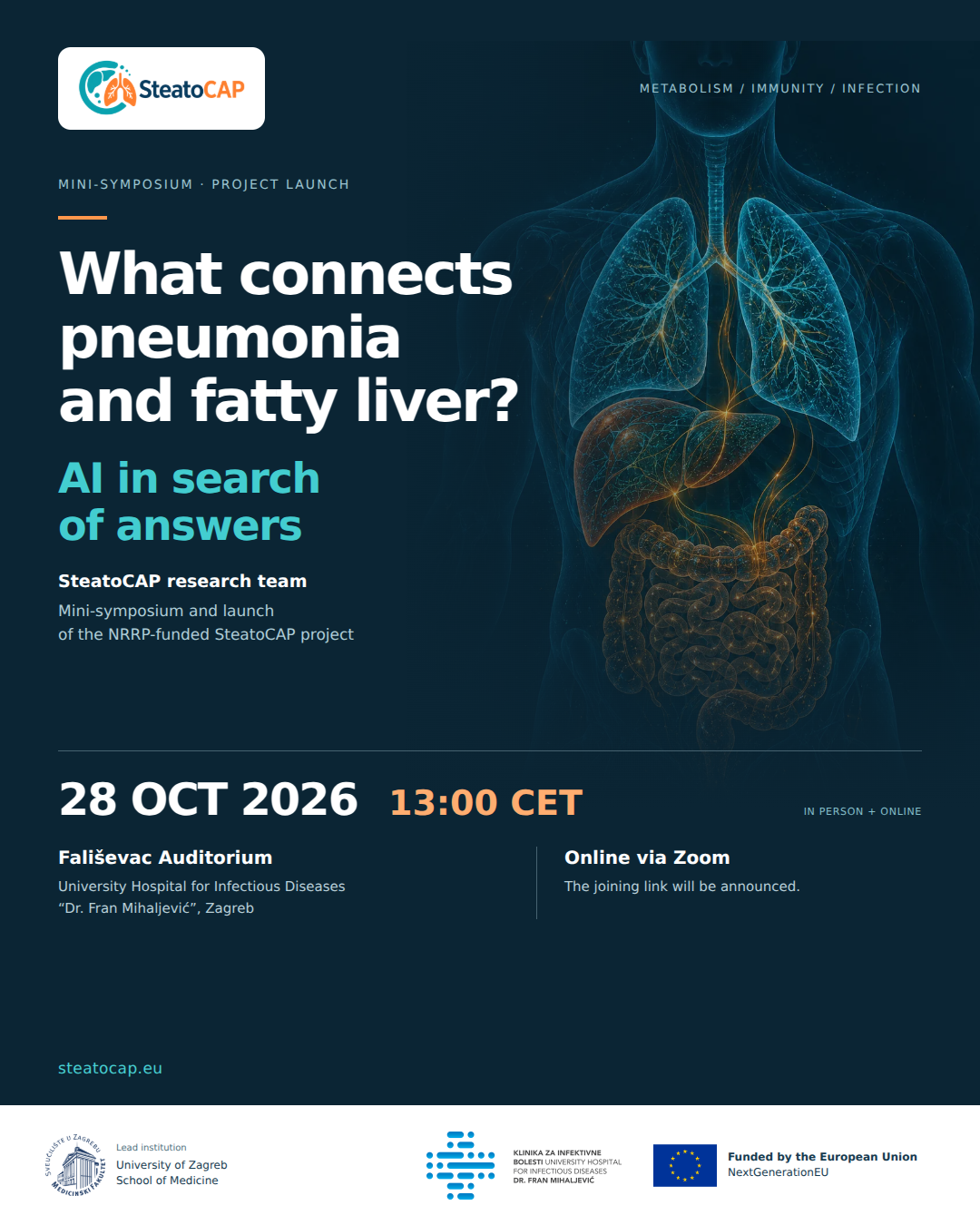
UPCOMING EVENT
AI in search of answers
SteatoCAP research team
Mini-symposium and launch of the NRRP-funded SteatoCAP project
The joining link will be announced.
We welcome clinicians, researchers and students interested in metabolism and infection.